This message is for all subscribers of Adobe Creative Cloud and all subscribers of Adobe Acrobat Pro who sign into these Adobe services using a UW NetID.
What’s happening and why
On Tuesday, Oct. 22, 2024, we will be implementing a change that will delete all UW user files saved to Adobe Creative Cloud storage. The change will allow the UW-IT Adobe support team to ultimately improve Adobe subscription services for the University.
Adobe files saved on local computers and networks will not be affected.
What you need to do
Please plan to move your files out of Creative Cloud and onto a local or network file storage location so that you have a backup. Visit our Online storage page to learn about file storage options for the UW community.
The work that UW-IT needs to do will begin on the morning of Oct. 22, and could take most of the day. During that time, you will not have access to your Adobe software. We apologize for the inconvenience.
“Files” means Adobe individual and Adobe project files, and any other files, that you have saved to Creative Cloud. Brand libraries will not be affected; those will still be available after the change.
Need more details? Scroll below to our Frequently Asked Questions (FAQs).
How to check for and access files in Creative Cloud:
Sign into Adobe Creative Cloud on your desktop or web browser with your UW NetID.
Select the “Files” icon on the left-hand side of the home screen. If you see files in this space, they are stored in Creative Cloud and you will need to move the ones you want to keep.
Questions?
Please refer to the FAQs below. You also can send a message to help@uw.edu if you have other questions or need further assistance.
Thank you,
UW Information Technology (UW-IT)
FAQs
Q. Will I be able to use Creative Cloud storage after this change?
A. Yes, if you like, you can use Creative Cloud storage after the Oct. 22 change.
Q. Will Creative Cloud libraries be affected?
A. No. Brand libraries will not be affected by the change.
Q. Will assets saved on Creative Cloud be affected?
A. Yes. Your user assets saved under your Adobe profile will need to be backed up, so be sure to do so.
Q. Do you have a backup service if I lose files on or after Oct. 22, 2024?
A. No. Any files not backed up will not be recoverable by UW-IT (nor Adobe) after the change.
Q. What happens to my Adobe Creative Cloud files when I leave the UW?
A. When you leave the UW, files saved in Creative Cloud under your UW Adobe profile will be deleted.
Q. Will I lose access to Adobe software during the change, and how long will this last?
A. Yes, unfortunately. A downtime of at least 4-6 hours is expected during the change, starting at 6:00 a.m. Pacific time on Oct. 22, 2024.
I came into the office the other day and there was no wired telephone handset on my desk.
And just like that, I had become an actor in a quiet technological revolution going on at the University of Washington and other work and study places across the globe: We are just not connecting our devices to ethernet ports as much as we used to.
Some of us have moved our UW phones to our computers, taking calls via Zoom or Teams. Others have ditched desktops for laptops and docking stations that use Wi-Fi.
At the UW, you can still find an ethernet connection at pretty much every workstation — practically all walls on all floors in all UW buildings have the ubiquitous four-port plate that connects us to the UW network and the world.
New technologies have freed many of our devices from cables. But many still need them.
Except that now, more and more people prefer to connect via Wi-Fi. And as Wi-Fi has continued to improve — with faster connections and better security features such as encrypted communications, for example — we are moving from a wired environment to one that is mostly untethered.
Does that mean Ethernet ports are going away? Not at all, said Dave O’Meara, service owner of the wired network service in UW-IT’s Infrastructure Division.
“At UW-IT, we completely understand that there’s a steady migration to wireless, but many people in our UW community will continue to require ethernet ports for all kinds of reasons. Ethernet connections are not going away,” he said.
What’s happening is the strategic deployment and maintenance of ethernet ports across UW — replacing or modernizing those that are in use and deactivating those that are not.
Now, this is not a simple step. UW-IT, particularly its infrastructure division, pays close attention to how technologies are deployed at the UW, and it sees the migration to more wireless devices as an opportunity to save everyone some money. In this case, to the tune of about $2 million in the next two to five years.
“As we started to modernize our ethernet ports, our engineers discovered that as much as 40 percent of available ports had not been used at all in the last 12 months,” said Bin Guo, vice president of the infrastructure division.
More and more computers at the UW are going wireless, and students are leading the way.
“It costs money to touch each and every one of those ports, so it makes no sense to refresh a port that’s not being used,” she said.
For Guo, paying attention to something as small as a four-prong port signals how nothing is too small for UW-IT’s commitment to serve the UW community.
“Saving about $2 million is highly significant. But just as important is how we keep pace with technological changes,” she said. “We adapt and innovate to better support the University.”
In the meantime, the wired service team has a plan to contact all building managers in advance before any changes are made to Ethernet ports.
Building managers will have a great deal of discretion to decide which ports will remain active even if they have not been used at all in the past year.
“Our goal is to work closely with building managers to ensure their connectivity needs are being met,” O’Meara said. “If you need an ethernet connection, you got it.”
If you have any questions about the Ethernet project or you’re a building manager who needs to get working on your connections right away, send a query to help@uw.edu with “ethernet ports” in the subject line.
UW introduces new app to support proper name pronunciation
With the Namecoach App available in Canvas, you can record your name without worrying about stage fright.
Text by Ignacio Lobos | UW-IT Strategic Communications
I was at a pizza joint recently and the cashier asked for my name so they could yell it out when my slices came out of the oven.
I hesitated for an uncomfortable few seconds and I finally told her, “Just make it Tony.” She gave me a glance that I read as, “You don’t look like a Tony to me!”
OK, so I was tired and hungry, and I didn’t want to hassle with another teachable moment, so surely you can understand. And come on, Ignacio is not that hard to pronounce. Just a handful of syllables.
And yet, over the years, my name has been mispronounced countless times — Over and over, in loud bars and pizza joints, in offices, and yes, in the classroom as well. Co-workers, friends, fellow students, a stubborn boss. All guilty as charged!
So, it’s great to hear that my employer, UW Information Technology, has acquired an app that is supposed to make it easier for people like me to share the proper pronunciation of our names.
This September, Namecoach will be unveiled in Canvas, the UW’s learning management system, and it will be available for students and faculty on all campuses first.
The app lets students (and faculty) create an audio recording of their name and enter a phonetic spelling if they want. The info is then accessible by others who have permission to use Canvas. Namecoach will appear as a tab in a Canvas course.
This is a big deal for a lot of people. Names matter. They’re an integral part of our identity. When you mispronounce someone’s name on purpose or make light of it, it’s certainly a show of disrespect. Don’t just take it from me. Check out this article from my colleagues in UW Medicine, which talks about why correct name pronunciation helps people feel respected and included.
So, say it with me: Ignacio! (a decent Youtube interpretation, until I get to make my own recording in Namecoach.)
When Jared Reimer joined the computer science program at UW nearly 30 years ago, the 17-year-old was more likely to find mentions of artificial intelligence (AI) in science fiction rather than the classroom.
Today, AI is on the cusp of becoming the most transformative technology of the 21st century — and as Reimer and many other tech industry leaders see it, more important than the Internet, cell phone or just about any other electronic gadget we put our hands on.
“This is a once-in-a-generation innovation, perhaps one of the most significant advances in technology in the last 100 years,” said Reimer, who has returned to the University as Lead AI Architect for University of Washington Information Technology (UW-IT).
“AI, no doubt, will change the world in ways we cannot imagine,” he said.
Hiring Reimer underscores UW-IT’s commitment to ensure AI will deliver on its promises and give UW a competitive advantage over other major universities, said Bin Guo, Associate Vice President of Infrastructure and CTO.
“This is a critical role for UW-IT and UW at large at this pivotal moment of the AI age,” Guo said. “Jared will help shape and implement our AI strategy to transform UW into a leading AI-powered University.”
UW alum brings rich AI experience across industries
Jared is no stranger to technology, even to the hype and promise of earlier technologies that have failed to deliver. But AI is not a passing fad, he said, pointing to his own children’s immediate adoption of Chat GPT and other generative AI technologies.
Jared Reimer, Lead AI Architect for University of Washington Information Technology (UW-IT).
“How we interact with technology will change fundamentally with AI,” said Reimer, an early Internet and cloud services industries pioneer.
Reimer grew up in rural Kitsap County, not far from UW, where he earned undergrad and graduate degrees in computer science. He started his career building core Internet infrastructure including oz.net (early dial-up ISP) and the Seattle Internet eXchange, the world’s largest free internet exchange point.
Later, he founded Cascadeo, an international professional and managed services firm. The company, which placed in the global Gartner Magic Quadrant for Public Cloud IT Transformation Services, was acquired in 2020 by a leading telecommunications provider in Asia.
Most recently, he served as Cascadeo’s CTO post-acquisition and led the cascadeo.ai SaaS product, the world’s first enterprise cloud management platform to leverage generative AI.
If you haven’t heard his name, you may know some of the things he has been involved in: launching the Nest Learning Thermostat, designing and building CenturyLink Cloud’s global monitoring infrastructure and serving as senior technical advisor to HBO’s Emmy award-winning comedy “Silicon Valley.”
Because of his expertise in cloud computing and AI, he’s become a sought-after speaker, including appearances at Goldman Sachs, AWS re:Invent, Warburg Pincus, KeyBanc, NANOG, CNN Philippines, The Wall Street Journal and many others, including guest lectures at UW.
Critical time for AI at UW
While a firm believer that AI is a force for good, Reimer also understands you need a strong plan and strategy to deliver AI that will advance the mission of the University.
“With any dual-use technology, we risk making a wrong turn,” he said, pointing to his favorite movie, Terminator 2: Judgement Day. “That movie was far ahead of its time and today, it’s more relevant than ever in the age of AI,” he said.
But we will not have a terminator day if we pay attention to how we deploy and police AI, he said. And we also can’t turn the clock back. AI is not going away — it continues to grow at a rapid pace across the globe.
“The ethical use of AI is of vital importance, especially in a university setting,” he said. “Building fairness around the system and guarding against bias are not terms we just throw around. We are deeply committed to UW’s mission and guiding principles.”
“Our work with AI foremost exists to serve the UW and its many stakeholders equitably,” he said. “It also aims to set a very high bar for others to follow.”
More information
Jared Reimer now helps lead UW’s new AI Community of Practice. Join today via UW Teams!
Video by Sam Han | Text by Ignacio Lobos | UW-IT Communications & Engagement
In one of your commercial flights over the Cascade Mountains, between snacks, bathroom breaks and terrible romantic comedies, did you ever stop to think about the massive engineering feat that kept the engines running?
Have you ever considered your own engine — reliably ticking away year after year?
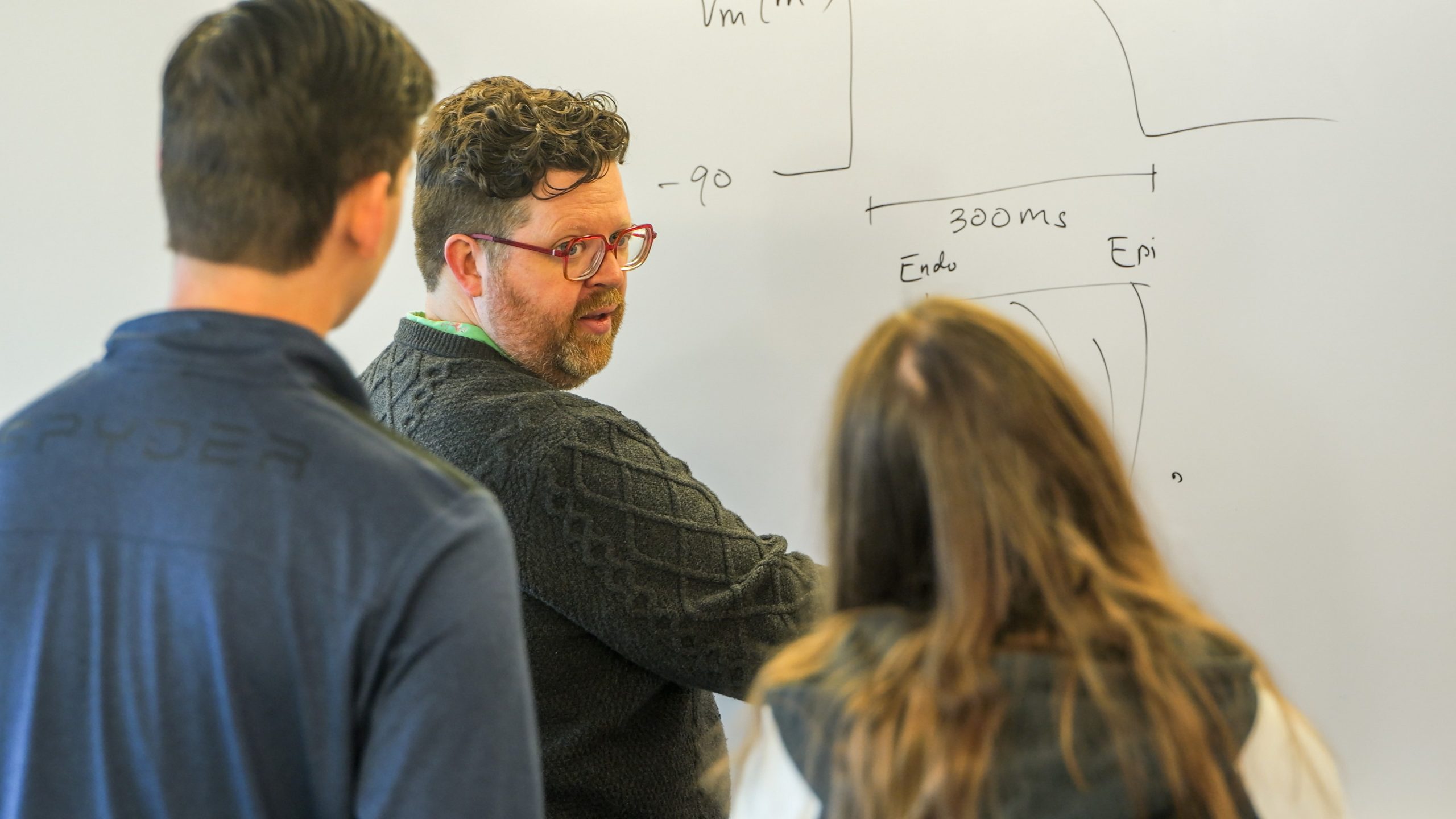
Patrick Boyle spends a lot of time thinking about the heart and the intricate electrical system that keeps it ticking along better than a Rolex ever could.
Boyle and his team in UW’s Cardiac Systems Simulation (CardSS) Lab in the Department of Bioengineering know the heart is an amazing workhorse, but they also know things go wrong.
That’s why they are using computational tools, machine learning, artificial intelligence and the power of Hyak, the UW’s supercomputer managed and operated by UW Information Technology (UW-IT), to spot electrical abnormalities before they turn into killing strokes.
“One of our areas of study is atrial fibrillation (AFib), an irregular heartbeat that causes the heart to beat too fast,” Boyle said. “It affects millions of people across the world, and it’s a terrifying disease.”
“It can be present, and your heart and body can tolerate the condition, and you may not know it at all,” he said. “For many people, the first sign there’s a problem is when they have a stroke.”
As its name implies, Boyle’s lab runs computational simulations of beating hearts to better predict and prevent electrical abnormalities. By studying heart rhythm disorders — specifically atrial and ventricular arrhythmias — the lab seeks to better understand why people suffer from heart disease and move health care technology forward.
Super heavy-duty computer users
An electrical abnormality is not an easy thing to track, much less predict. And that’s where the power of Hyak comes into play. It allows Boyle and his lab to run uninterrupted studies that can shed light on what’s making things go haywire.
Patrick Boyle and his team analyze data from one of their studies on electrical abnormalities.
His lab is also using many complex open-source packages maintained by the openCARP community, whose software and code is freely available for academic purposes; and powerful new tools created by numericor, which provides cutting-edge cardiac electrophysiology simulation solutions.
“We’re grateful to have amazing software tools to use in our work, and on-premises supercomputer to crunch the data,” he said. “We’re fortunate to have a resource like Hyak. For us, a single study has enough data to consume 3 to 4 million CPU hours. That’s an incredible amount of computing power,” he said.
And he needs every bit of it. He and his team are not studying one heart. They are studying thousands of electrical permutations in hundreds of hearts, all of them beating at their own rhythm and creating incredibly complex data points that add up to an incredible puzzle that the CardSS Lab can’t wait to crack.
From the early hours of this morning, our UW-IT team has been monitoring and recovering the Microsoft/CrowdStrike outage.

Once it was determined that this was an international outage with no harmful intent, our incident management team assembled to manage communications and connectivity. We also reached out to the Computing Directors for updates and insights to ensure that all of our user segments were informed and aligned with expectations.
The UW-IT availability issues are all resolved. SolarWinds, the software we use for monitoring and maintaining our network, is now operational but not yet in high availability. Once our team has rested, they’ll work to ensure SolarWinds returns to high availability.
We will continue to monitor the network’s health to ensure that speed, connectivity, reliability, and efficiency remain unaffected.
If you’re about to hit the road, don’t forget to set up your devices with eduroam, the UW’s preferred Wi-Fi app. It’s secure and encrypted, but better yet, it’s accepted at more than 30,000 points across the globe. Check it out!
When Bethany Brodsky is not operating as an HR executive — solving tough people problems and coaching those around her to do the same — you will likely find her busy with various activities, most involving her family and her community.
One meaningful role her family has played has been as a host to refugees from Afghanistan and other politically troubled places across the globe.
For refugee families, learning how to navigate a new country, learning a new language, and adapting to new norms can be emotionally difficult — and often an exciting journey as well.
In this context, culture is all too important for Bethany, her family and for refugees. As a host family, new immigrants have someone they can trust as they navigate new ways of doing things. For Bethany and her family, helping people on their journey to new lives has been an eye-opening and a mutually rewarding experience.
That ethos is reflected in Bethany’s professional choices, where people always come first. Over the years at different companies, she was immersed in leading culture change — advocating for healthier workspaces, mapping career development for staff, building cohesive talent strategies for organizations, and coaching leaders on thoughtful growth and change.
This week, Bethany starts a new chapter in her career, as Associate Vice President of People & Culture — also a brand-new division within University of Washington Information Technology (UW-IT).
“It’s an incredible opportunity to be able to step into a brand-new role and brand-new division that puts people first,” Bethany said.
“It’s clear that UW-IT has highly competent, talented individuals who really care about the University,” said Bethany, who endured a rigorous interview process, including a forum attended by about 100 UW-IT staff and leaders. “I see my job partly as helping clear the way for talented and capable teams within UW-IT to do their best work on behalf of the University.”
Her goals and insight impressed UW leaders and staff during the competitive interview process.
“Bethany’s leadership style is grounded in vision and empathy, aligning with our goals and the journey we are on,” said Andreas Bohman, vice president and chief information officer for UW-IT.
“Her skills and insights will be crucial as we continue to evolve and strengthen our organization,” Andreas said. “We believe Bethany is the leader UW-IT needs, and we are excited for the fresh perspectives and energy she will bring to our team.”
New division seeks to empower UW-IT staff
The People & Culture Division is a product of UW-IT’s extensive reorganization, which got under way in 2022. UW-IT staff asked for more support and clear values, which the new division seeks to deliver.
Today, UW-IT as an organization has chosen a set of core values to foster a healthier organization. In turn, these values are meant to guide UW-IT in support of UW’s mission, how UW-IT goes about its work and how its staff collaborates with one another and the UW community.
“UW-IT’s People & Culture division aims to ensure that our workforce is set up for success, and to maximize the value of our human capital,” Andreas said. “Bethany will help us achieve those goals.”
Bethany has a strong background in talent development and organizational strategy and accomplished important goals at Netflix and Evernote.
“Her experience in creating a learning and development function at Netflix and leading a global talent initiative at Evernote showcases her strategic thinking and dedication to professional growth,” he said.
We are getting a lot of questions about email forwarding issues. We are not disabling email forwarding for @uw.edu domains, but you may still be affected by actions being taken by commercial email companies. Stay informed!
Three units within UW-IT’s Infrastructure Division critical to the University of Washington’s business functions now have new leaders — a key step in a major reorganization that was completed in late 2023.
Scott Bingham is Director of Microsoft Platforms, a new unit in UW-IT; David Cox is Director of Computing and Storage; Joby Walker is Director of Infrastructure Tools.
Strengthening UW’s partnership with Microsoft
UW students, faculty and staff rely on multiple IT tools and apps to accomplish their work, but over the years, as the University has sought to streamline its offerings, Microsoft tools have grown in importance.
Scott Bingham, Director of Microsoft Platforms
“With our new Microsoft Platforms unit, we aim to elevate our partnership with Microsoft and maximize the value of Microsoft technologies for University business,” said Bin Guo, Infrastructure’s associate vice president.
“Scott will help us to strengthen our partnership with Microsoft, and at the same time, work with other UW-IT teams to curate relevant Microsoft technologies and continue to deliver premium services to our community,” she said.
Scott brings broad technical expertise across applications, infrastructure, program and project management, and IT operations. “And he is proficient in bringing together technology and business strategy to solve unique challenges,” she said.
Scott is no stranger to UW, where he received a Computer Science degree. He has more than 20 years of experience leading technology teams delivering high-value digital solutions and services.
For the last 12 years, he served in various IT leadership roles at Seattle Children’s, and most recently has led the IT Operations department, where he implemented and supported a large portfolio of digital solutions and services across the Hospital, Research Institute and 40 remote clinical sites.
Scott is also the founder and president of Housing Solutions for Hope (HS4H), a Seattle Children’s non-profit — showcasing his deep passion for Diversity, Equity, and Inclusion (DEI) in support of under-represented communities.
Cutting-edge computing and storage solutions coming to the UW
The Computing and Storage unit also will play a critical role as the University seeks new business solutions in the short- and long-term, Guo said.
David Cox, Director of Computing and Storage
“We are at a pivotal point of leading the university into the next era, and the Computing and Storage unit continues to play a key role in that journey,” Guo said.
“This includes a few major efforts like defining and driving the implementation of next generation student systems in collaboration with our partners in the Data and Applications Division, modernizing of our on-premises storage solutions and expanding our computing environment to the cloud.
David is well known around UW, where he has been contributing to its mission in different roles and capacities for more than 30 years — with outstanding results. He has diverse technical knowledge and experience as well as leading teams in various areas.
“It’s a super exciting journey ahead and we are glad to have David onboard,” she said.
Infrastructure tools key to smooth University business operations
The Infrastructure Tools team already has played an instrumental role in Finance Transformation by enabling UW Connect (ServiceNow) to be the enterprise customer support platform, Guo said.
Joby Walker, Director of Infrastructure Tools.
Under Joby’s leadership, she expects the unit will continue to scale up the capabilities to enable more business workflows and onboard more university customers efficiently.
UW-IT also oversees a vast portfolio of tools to support the management of the backbone IT infrastructure for the university, including project management and developer tools. But as University priorities change, the Infrastructure Tools unit will play a key role in building a solid roadmap for years to come.
“Joby is perfect for this role,” Guo said. “He has been contributing to UW’s mission in different roles and capacities for more than two decades and he has a great track record of delivering outstanding results in an extremely collaborative and pragmatic manner.”
“He also brings diverse technical knowledge and experience and is a great example of the embodiment of our three core values — invested, compassionate and team player.”
“I am confident that Joby will help us lead through this growth and pave the way forward,” Guo said. “It’s a super exciting time.”
Leadership changes reflect UW-IT’s path to a dynamic future
Bin Guo, Infrastructure Division AVP
In the past year, UW-IT has transformed itself and created new divisions and units, committing itself to a new work model focused on the people who depend on IT tools and services.
The new hires and units, Guo said, go a long way to fulfilling Infrastructure Division’s mandate. As part of its work, various units design, implement and support essential IT infrastructure services and technologies that are indispensable to carrying out the University’s mission.
They include the University’s wired and wireless networks, telecommunications services, computing and storage services, infrastructure tools and service delivery platforms. At the same time, Infrastructure works closely with other divisions in UW-IT to ensure the right IT solutions are in place. See where Infrastructure and its units fit within UW-IT.
“We are very excited to have such committed leaders in UW-IT,” Guo said. As UW-IT continues to position itself to better serve the University’s mission, we need a strong vision to get us there.”